
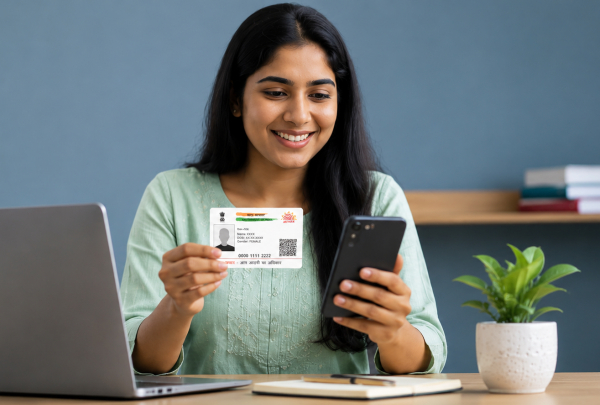
How Aadhaar helps in KYC verification?


Table of Content
KYC is one of those banking terms that almost everyone has come across. You hear it while opening an account, updating your details or applying for another banking service.
The process itself has changed quite a bit over the years.
There was a time when people walked into a branch carrying a folder filled with documents, hoping everything required was inside. If one paper was missing, another visit often became part of the plan. Banking has gradually become more convenient, and identity verification has changed along the way.
That is where Aadhaar KYC verification has become an important part of the process.
What is Aadhaar KYC Verification?
Since Aadhaar contains basic identity and address details, it can be used for KYC wherever applicable and in accordance with regulatory guidelines. For customers, this often means fewer documents to organise and smoother experience while completing banking formalities.
KYC, or Know Your Customer, by virtue of its nomenclature is simply a way for banks to confirm the identity of their customers. It also helps keep customer records up to date. Whenever there is a change in personal information, such as an address or another important detail, banks request customers to update their KYC information so that their records remain accurate and updated with the Bank.
Aadhaar is one of the officially valid documents that may be used during the KYC verification process, wherever applicable. Depending on the banking product or service, other documents may also be required to complete verification of a customer.
This is why Aadhaar verification has become such a familiar phrase. It supports the KYC process while making it easier for customers to establish their identity through a document they already possess.
How Aadhaar-Based KYC Verification Works
At DCB Bank, Aadhaar based KYC verification helps make this process simpler for eligible customers. Aadhaar details are verified through the Unique Identification Authority of India as part of the e KYC process, in line with applicable regulatory guidelines. Depending on the service being used, verification can be completed either through biometric authentication at a branch or through an OTP sent to the mobile number linked with the Aadhaar.
How to Update KYC Using Aadhaar at DCB Bank
Customers who wish to update their KYC can also complete the process through the DCB Bank Self Service portal. After signing in using their Customer ID or PAN, they can choose the KYC update option, select Aadhaar for verification and authenticate the request using the OTP received on their registered mobile number. Once submitted, the request is processed and completed through V-CIP, completing the journey seamlessly. This the customer can process from the comfort of his home/ office or any location!
Those who prefer visiting a branch can carry their Aadhaar card to the nearest DCB Bank branch, where a bank representative assists with biometric verification or the offline KYC update process, wherever applicable. Eligible customers may also request doorstep banking for KYC updates, making the experience more convenient.
Benefits of Aadhaar KYC Verification
Convenience has become an important part of banking. People expect everyday tasks to take less time than they did a few years ago. Identity and KYC verification is no exception.
Digital banking has played a big role in that change. Customers can often begin the verification process online, depending on the banking service and applicable guidelines. The experience feels much simpler than it once did, even though the purpose of KYC remains the same.
This is one reason Aadhaar KYC has become a familiar part of modern banking. It supports a process that is already essential while making it easier for customers to complete the required formalities using a document they already have.
Why Aadhaar KYC is Important for Modern Banking
Banking continues to evolve, but some processes remain essential because they help create a strong foundation. KYC is one of them. Aadhaar has made this process more convenient for millions of customers by supporting identity verification through a document that is already widely used.
Understanding Aadhaar KYC verification, knowing how Aadhaar verification fits into the KYC process and recognising where Aadhaar based KYC verification can be used, it helps customers approach banking formalities with greater confidence.
DCB Bank continues to simplify this journey through convenient verification options, helping customers complete KYC with ease while following applicable regulatory requirements.
Disclaimer
Information on the website is for informational purposes only and does not constitute financial advice. Readers are advised to consult financial professionals for personalized advice before making decisions. The information on this blog is subject to change without notice and may become obsolete. DCB Bank reserves the right to modify, update, or remove content at any time. Savings Account and Fixed Deposit Interest rates are subject to change without prior notice. DCB Bank shall not be responsible for any direct / indirect loss or liability incurred by the reader for taking any financial decision based on the contents and information mentioned in this blog. By accessing and using this blog, users agree to adhere to these terms and conditions. For complete terms and conditions, please click here or to read the complete disclaimer of DCB Bank, please click here
















DCB Customer Care


Follow us on


Download DCB Mobile Banking App